

What is a Ghost?

Few questions have followed humanity as persistently as this one: What is a ghost? Across cultures and centuries, people have reported apparitions, shadowy figures, unexplained voices, and the lingering presence of the dead. Traditionally, a ghost is described as the surviving essence of a once-living person, capable of being seen, heard, or felt. Yet once we move beyond folklore, the question becomes far more complex.

From a scientific perspective, there is currently no accepted empirical proof that ghosts exist as independent conscious entities. Many experiences are explained through psychology, neurology, and environmental factors. Hallucinations, sleep paralysis, grief responses, suggestion, infrasound, electromagnetic fluctuations, and even poor lighting can all shape perception. The human brain is remarkably adept at constructing convincing experiences, especially in emotionally charged situations. Bereavement visions, for example, are common and deeply meaningful, yet they do not necessarily imply the presence of an external spirit.
Another hypothesis suggests that hauntings may be environmental recordings rather than conscious beings. Often linked to the Stone Tape Theory, this idea proposes that intense emotional events may imprint themselves onto surroundings and replay under certain conditions. In this model, a ghost is not aware; it is more like a residual echo that repeats the same sequence without interaction.

However, not all reported encounters fit easily into these categories. Some involve apparent intelligence and responsiveness, leading to paranormal interpretations. Within spiritual traditions, a ghost is typically understood as the surviving soul or spirit of a deceased person, retaining memory and personality. Some belief systems suggest such spirits remain earthbound due to attachment, confusion, or unfinished business.
If we assume, even hypothetically, that a ghost is real, a more technical question arises: what is it made of? One possible avenue lies in the body’s electrical nature. Every living cell maintains a small electrical potential across its membrane. The nervous system operates through electrochemical signals, the heart generates measurable electrical fields, and the brain’s activity is electrically detectable. Human life is sustained by finely balanced bioelectric processes.
If we consider the approximately 50 trillion cells in the human body, each with a membrane potential of around 0.07 volts, the theoretical aggregate electrical potential of the body, when conceptually combined, could be around 35 trillion volts. This is not comparable to a lightning strike or a power grid, as it is microscopic and distributed throughout the body. Nevertheless, it underscores that we are fundamentally bioelectrical organisms.
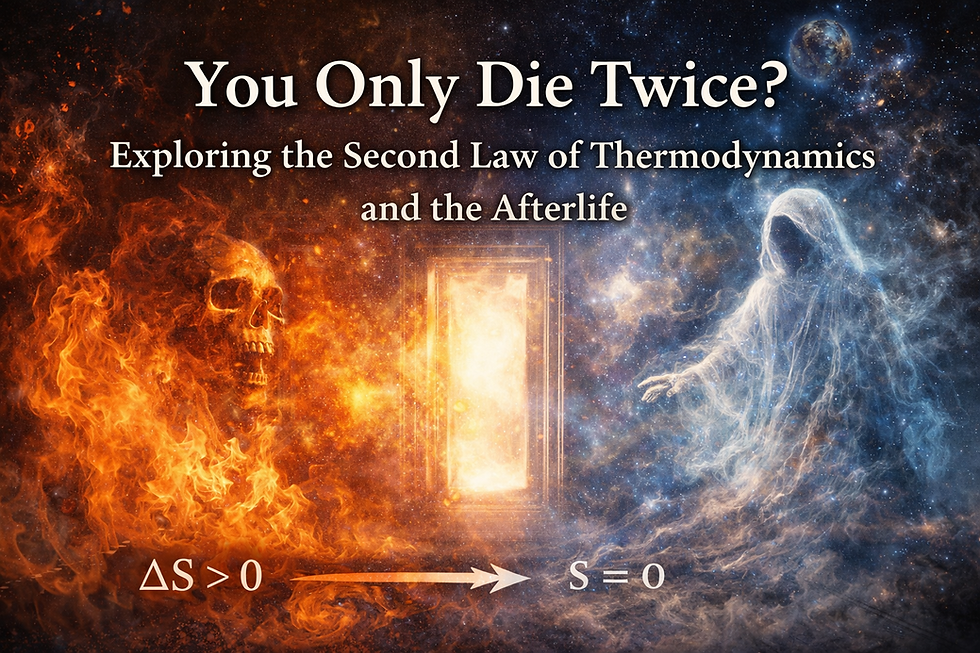
When death occurs, conventional biology holds that this electrical organisation collapses. Energy disperses, gradients equalise, and entropy increases in accordance with the Second Law of Thermodynamics. In simple terms, systems move from order to disorder unless energy is continually supplied. If a ghost were a residual bioelectrical pattern of a once-living human, it too would be subject to this law. Without replenishment, it would gradually lose structure, weaken, and disperse. In this view, a ghost might not be eternal. It could slowly fade, effectively dying a second time as its organised energy dissipates.

The thermodynamic perspective might explain why some hauntings appear to diminish over decades. A residual energy construct would not vanish instantly but would fragment and disperse over time. However, this explanation struggles to account for apparently intelligent or interactive phenomena.
Here, the discussion becomes more speculative. Some researchers propose that consciousness may not be entirely reducible to classical brain chemistry. Quantum models of consciousness, though controversial, suggest that awareness may involve subatomic processes. If consciousness is fundamentally quantum, then what we call the soul might represent a quantum information structure rather than merely electrochemical activity. Certain interpretations of physics propose that quantum information cannot be destroyed, only transformed.
In such a scenario, a distinction might exist between a fading bioelectrical residue and a deeper quantum consciousness. The former could dissipate under thermodynamic law, while the latter, if genuinely quantum in nature, might persist indefinitely. This could provide a theoretical framework for differentiating between residual hauntings and what are perceived as sentient spirits.
There are also hybrid possibilities. What we perceive as ghosts may arise from interactions between the living brain and environmental fields. Under certain conditions, human consciousness might resonate with lingering patterns, reconstructing an experience that feels external but is partly generated within.
None of these explanations has been conclusively proven. Sceptics rightly demand rigorous evidence, and science has yet to confirm the existence of ghosts as independent entities. Yet history shows that scientific understanding evolves. Phenomena once considered impossible have later been measured and explained.
So what is a ghost? It may be a psychological projection, an environmental echo, a dispersing bioelectrical structure subject to entropy, a quantum aspect of consciousness, or some combination of these ideas. If ghosts exist, they may not be fixed, eternal figures wandering endlessly, but dynamic processes shaped by energy, information, and the laws of physics.
The question remains open. Whether ghosts are illusions, echoes, energy forms, quantum souls, or something not yet imagined may ultimately depend on future discoveries, and on how we choose to interpret the mysteries that still surround life and death.
Help, if Needed.
If you or someone you know repeatedly dismisses strange experiences while quietly feeling unsettled, early guidance can prevent escalation. Confidential help is available from Paranormal Rescue, which operates as a sort of fifth emergency service, addressing incidents that fall outside the remit of police, fire, medical, or breakdown services. When unexplained disturbances disrupt normal life, Paranormal Rescue provides calm, structured, evidence-based support.

Written by Brian Sterling-Vete, PhD and Helen Renée Wuorio, TM, RM.
Founders of the Paranormal Rescue Organisation - www.ParanormalRescue.com
British-born Brian Sterling-Vete is a veteran science-based paranormal researcher, field investigator, quantum consciousness researcher, and author with decades of experience researching unexplained phenomena.

American-born Helen Renée Wuorio is a Tarot Master, Reiki Master Teacher, and author. She specialises in intuitive perception, historical symbolism, and research into experiential and quantum consciousness.
Together, they head Paranormal Rescue, a global organisation offering a unique and discreet emergency assistance service and support for those dealing with complex, malevolent and occasionally dangerous paranormal situations.


Comments