

Poltergeist

Poltergeists Through History

Few paranormal phenomena have captured the public imagination quite like the poltergeist. The very word comes from German, with “poltern” meaning to make noise or rumble and “geist” meaning spirit. Unlike traditional ghost stories that often involve apparitions or shadowy figures, poltergeist cases are usually associated with movement, chaos and disruption. Loud banging sounds, objects flying across rooms, unexplained fires, electrical disturbances and even physical attacks have all been linked to alleged poltergeist activity.
Accounts of such disturbances stretch back centuries. Ancient Roman writings described strange happenings in homes, while medieval Europe recorded stories of invisible forces throwing stones, rattling furniture and tormenting families. In many cases, these events were interpreted through the religious understanding of the time, with demons, curses or angry spirits blamed for the disturbances.
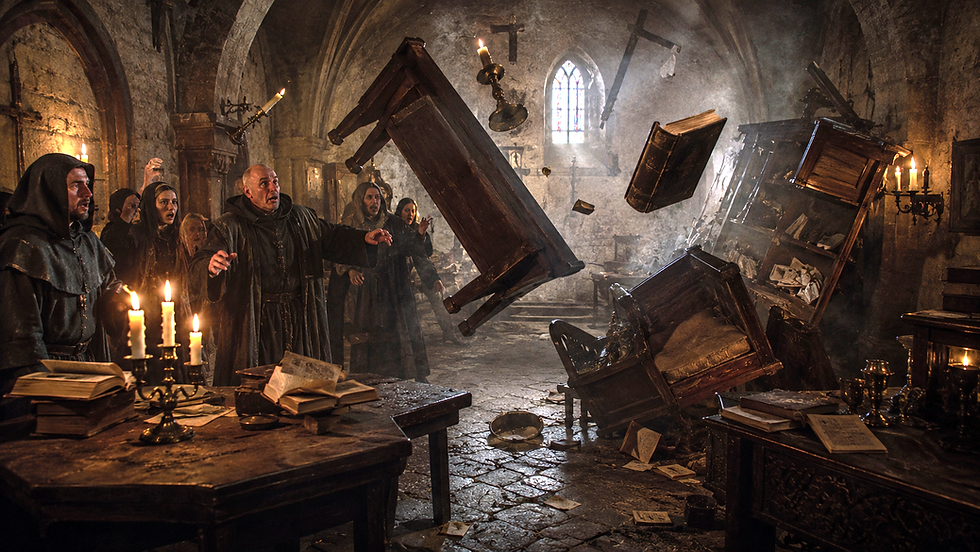
As societies evolved, so too did interpretations of these strange events. What was once considered obvious evidence of evil spirits later became associated with hauntings, psychic powers or unexplained psychological phenomena. Yet despite advances in science and technology, the mystery surrounding poltergeists has never fully disappeared.
Famous Poltergeist Cases
Perhaps the most famous modern case is the Enfield Poltergeist, which occurred in North London in the late 1970s. The case centred around the Hodgson family, particularly two young sisters, Janet and Margaret. Witnesses reported furniture moving on its own, knocking sounds echoing through the house, toys being thrown, and strange voices that seemed to come from Janet herself.
The case attracted enormous media attention and was investigated by members of the Society for Psychical Research, as well as paranormal investigators, including Maurice Grosse and Guy Lyon Playfair. While sceptics argued that at least some of the phenomena had been exaggerated or faked by the children, others remained convinced that genuine unexplained events had occurred.

Another famous case was the Bell Witch in early nineteenth-century America. According to local legend, the Bell family experienced violent disturbances including strange noises, physical attacks and mysterious voices. The case became deeply embedded in American folklore and remains one of the best-known supernatural legends in the United States.
Germany has also produced several famous reports, including the Rosenheim case of the 1960s, where office equipment allegedly malfunctioned repeatedly around a young employee. Lights burst, telephones dialled themselves, and heavy objects reportedly moved without explanation. Scientists, engineers and police became involved, yet the case still provokes debate today.
The Paranormal Perspective
From a paranormal viewpoint, poltergeists are often considered fundamentally different from ordinary hauntings. Traditional ghosts are typically viewed as the spirits of the deceased, whereas poltergeist phenomena are frequently described as more aggressive, energetic, and chaotic.
Some paranormal researchers believe poltergeist activity may involve spirits attempting to communicate through physical interaction with the environment. Others suggest darker entities or non-human intelligences could be involved. In religious traditions, particularly within Christianity, some cases have historically been interpreted as demonic oppression or infestation.

An interesting feature of many poltergeist reports is the apparent connection to adolescents, especially teenagers experiencing emotional stress or upheaval. This has led some paranormal theorists to propose that certain individuals may unknowingly act as catalysts for psychokinetic energy. According to this theory, intense emotions could somehow externalise energy capable of affecting the physical environment.
This idea became especially popular during the twentieth century, when researchers began exploring concepts such as telekinesis and psychokinesis. Rather than invisible spirits moving objects, some investigators suggested the disturbances might originate from the unconscious mind of a living person. In this interpretation, the individual at the centre of the activity may not even realise they are somehow contributing to the events.
Those who support paranormal explanations often point to eyewitness testimony, multiple witnesses, unexplained recordings and the emotional intensity surrounding many cases. They argue that while fraud undoubtedly exists in some instances, not every event can be easily dismissed or explained away.
The Science-Based Perspective
Scientists and sceptics approach poltergeist claims very differently. From a scientific perspective, extraordinary claims require extraordinary evidence. Many researchers argue that there is currently no reliable proof that supernatural entities or psychic forces exist.
A large number of alleged poltergeist cases have eventually been exposed as hoaxes, misunderstandings or exaggerations. Children or teenagers seeking attention have admitted to secretly moving objects or creating noises. In other cases, investigators discovered natural explanations such as faulty plumbing, vibrations from nearby traffic, structural movement within buildings or electrical issues.
Psychology also plays an important role in science-based interpretations. Human perception can be unreliable, especially during stressful or emotionally charged situations. Once people begin believing a location is haunted, ordinary events may suddenly seem sinister or paranormal. Memory distortion, suggestion and group psychology can further reinforce these beliefs.
Sleep paralysis, anxiety disorders and environmental factors such as mould exposure or infrasound have also been explored as possible contributors to paranormal experiences. Infrasound, which consists of very low-frequency vibrations, has been linked to feelings of unease, fear and even visual disturbances in some studies.
Even so, some scientists acknowledge that certain cases remain difficult to fully explain. This does not necessarily prove the paranormal; rather, it highlights the complexity of human experience and the limitations of current understanding.

Between Belief and Scepticism
Poltergeists continue to occupy a fascinating space between folklore, psychology and the paranormal. For believers, they may represent genuine evidence that unseen forces exist beyond our current scientific understanding. For sceptics, they serve as powerful examples of how fear, emotion and human perception can shape reality.
What makes the subject so enduring is that it resists simple answers. Some cases collapse completely under scrutiny, while others leave lingering questions that continue to puzzle investigators decades later.
Whether poltergeists are spirits, unconscious psychic phenomena, misunderstood natural events, or elaborate human creations ultimately depends on the observer's perspective. Perhaps that uncertainty is exactly why the subject continues to fascinate people around the world.
Help, if Needed.
If you or someone you know repeatedly dismisses strange experiences while quietly feeling unsettled, early guidance can prevent escalation. Confidential help is available from Paranormal Rescue, which operates as a sort of fifth emergency service, addressing incidents that fall outside the remit of police, fire, medical, or breakdown services. When unexplained disturbances disrupt normal life, Paranormal Rescue provides calm, structured, evidence-based support.

Written by Brian Sterling-Vete, PhD and Helen Renée Wuorio, TM, RM.
Founders of the Paranormal Rescue Organisation - www.ParanormalRescue.com
British-born Brian Sterling-Vete is a veteran science-based paranormal researcher, field investigator, quantum consciousness researcher, and author with decades of experience researching unexplained phenomena.

American-born Helen Renée Wuorio is a Tarot Master, Reiki Master Teacher, and author. She specialises in intuitive perception, historical symbolism, and research into experiential and quantum consciousness.
Together, they head Paranormal Rescue, a global organisation offering a unique and discreet emergency assistance service and support for those dealing with complex, malevolent and occasionally dangerous paranormal situations.


Comments