

Do We Haunt Ourselves? A Closer Look at the Shadows We Carry and the Spirits We Might Unknowingly Invite

Most of us think of hauntings as something that happens to us from the outside. A cold draught in a warm room, a whisper that doesn’t belong to any living voice, a shadow that moves with its own intention, these are usually framed as intrusions from another realm. Yet there’s a quieter, more unsettling possibility that lingers beneath many supernatural accounts: what if the haunting begins within? And if it does, does that mean the experience is purely psychological, or could our inner world act as a beacon that draws in something external?
It’s a question that sits somewhere between psychology, folklore, and the paranormal. And like all questions worth asking, it refuses to settle neatly into one explanation.

The Mind as Its Own Haunted House
Psychology has long suggested that the human mind contains rooms we rarely enter. Some are locked. Some are cluttered with memories we’ve pushed aside. Some echo with emotions we’ve never fully processed. When people report supernatural encounters, the sense of being watched, the feeling of a presence, the sudden appearance of a figure in the corner of the eye, psychology often looks first to the subconscious.
The mind is capable of extraordinary projection. It can take fear, grief, guilt, or trauma and give it shape. It can create sensations that feel external even when they originate internally. Sleep paralysis is a well‑known example: countless people across cultures describe the same terrifying figure, the same crushing weight, the same sense of malevolence. Yet the experience is rooted in a neurological glitch between dreaming and waking. The terror is real, but the entity is not, at least according to the clinical explanation.
Carl Jung took this further, suggesting that archetypes, universal symbols embedded in the collective unconscious, can rise to the surface in moments of stress or vulnerability. A ghostly woman might represent loss. A dark figure might embody suppressed anger. A child’s laughter in an empty room might echo a longing for innocence or a reminder of something unresolved.
In this view, hauntings are mirrors. They show us what we’ve hidden from ourselves. But this explanation, while compelling, doesn’t account for everything people experience.
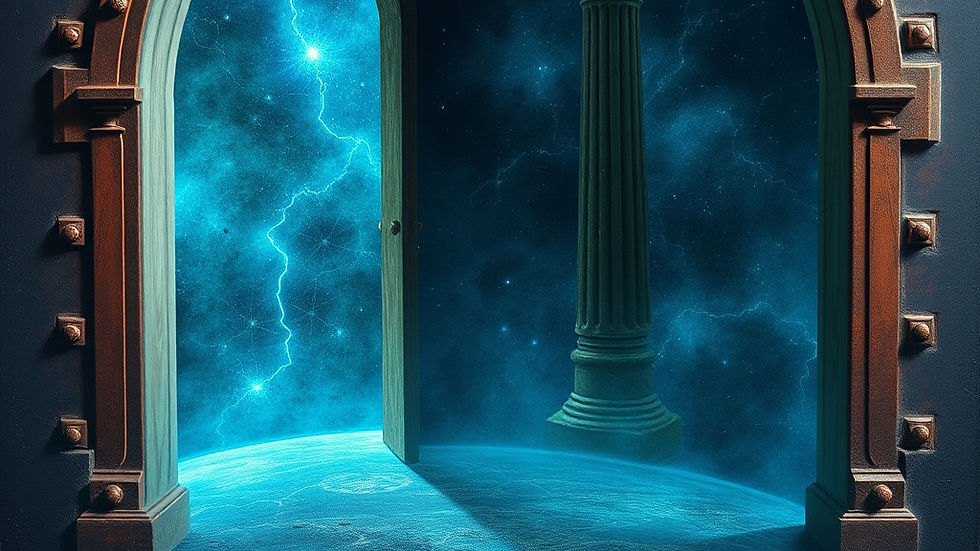
When the Mind Becomes a Doorway
There’s another perspective, one that resonates strongly with paranormal investigators and spiritual traditions across the world. It suggests that the mind doesn’t just create experiences, it can also attract them.
If emotions, thoughts, and intentions carry energy, then certain states of mind might act like signals. Fear, grief, and emotional turmoil could weaken the boundaries between the self and the unseen. People often report hauntings during periods of upheaval: after a bereavement, during a divorce, or in the midst of depression. These moments leave us raw, open, and energetically unguarded.
Some believe that malevolent entities, whether spirits, residual energies, or something more ambiguous, are drawn to this vulnerability. Not because we imagine them, but because we invite them without meaning to. The haunting, in this sense, is not self‑generated but self‑summoned.
This idea appears in countless cultures. In some traditions, spirits are thought to feed on emotional energy. In others, they slip through cracks created by psychological distress. Even modern paranormal investigators sometimes speak of “emotional resonance” or “energetic openings” that allow entities to attach themselves to individuals.
From this perspective, the mind is not a projector but a doorway. What steps through that doorway may not be of our own making.
Where the Psychological and the Paranormal Overlap
Of course, the line between internal and external is rarely clear. Many experiences sit somewhere in the middle, where psychology and the paranormal overlap in ways that are difficult to untangle.
Consider the idea of a thoughtform, a concept found in occult traditions, Tibetan mysticism, and modern paranormal theory. A thoughtform is a mental creation that becomes so charged with emotion and intention that it takes on a kind of independent existence. It begins as a psychological phenomenon but can behave like an external entity.
If this is possible, then the question “Is it in my head or outside of me?” becomes almost meaningless. The answer could be both.
Similarly, some hauntings seem to respond to the emotional state of the witness. A person who is anxious might experience more activity. Someone who is calm might experience less. This doesn’t necessarily mean the haunting is imaginary. It could mean that, if there is one, the entity interacts with the emotional energy available to it.
In this middle ground, the mind and the supernatural are not separate realms but intertwined systems. One influences the other. One shapes the other. One may even create the conditions for the other to appear.

The Stories We Tell Ourselves
Another perspective worth considering is the narrative one. Humans are storytellers by nature. We make sense of the world by weaving events into patterns. When something strange happens, a noise in the night, a shadow that shouldn’t be there, we reach for the stories we know.
If you’ve grown up hearing ghost stories, you might interpret a creak in the floorboards as a presence. If you’ve experienced trauma, you might interpret the same sound as a threat. If you’re spiritually inclined, you might see it as a sign.
This doesn’t mean the experience is false. It means the meaning we attach to it is shaped by who we are.
In this sense, we haunt ourselves not with spirits but with interpretations. The supernatural becomes a language through which we express fear, longing, or unresolved emotion. The ghost becomes a metaphor, but one that feels real enough to touch.
The Possibility of Genuine Encounters
And yet, there are cases that resist psychological explanation. Multiple witnesses saw the same figure. Objects moving independently. Electronic disturbances. Voices captured on recordings. These events challenge the idea that hauntings are purely internal.
If external entities exist, the question is not whether the mind creates them, but whether the mind influences when and how they appear.
Perhaps spirits are always present, but only those in certain emotional or psychological states are able to perceive them. Perhaps the mind acts as a receiver, tuning into frequencies that most people filter out. Perhaps trauma, grief, or fear doesn’t create the haunting but heightens the sensitivity to it.
In this view, the haunting is real, and the mind is simply the instrument through which it is experienced.
So, Do We Haunt Ourselves?
The truth may be that hauntings are not one thing but many. Some are psychological echoes. Some are emotional projections. Some may be encounters with external entities. And some may be a blend of all three.
The mind is a complex, layered, and often mysterious place. It can deceive us, protect us, reveal things we’d rather not see, and open doors we didn’t know existed. Whether those doors lead inward or outward is a question that remains open.
Perhaps the most unsettling possibility is that the boundary between the inner and outer worlds is far thinner than we imagine. Perhaps hauntings are not simply events but relationships, between memory and environment, between emotion and energy, between the living and whatever lies beyond.
And so we’re left with questions rather than answers. When we feel a presence, is it a fragment of ourselves or something watching from the dark? When we sense a haunting, are we confronting our own shadows or someone else’s? And if the mind can summon, attract, or create these experiences, what does that say about the power we carry within us?
The next time you feel a chill in an empty room, you might wonder not just what is haunting you, but why, and whether the haunting began long before you noticed it.
Help, if Needed.
If you or someone you know repeatedly dismisses strange experiences while quietly feeling unsettled, early guidance can prevent escalation. Confidential help is available from Paranormal Rescue, which operates as a sort of fifth emergency service, addressing incidents that fall outside the remit of police, fire, medical, or breakdown services. When unexplained disturbances disrupt normal life, Paranormal Rescue provides calm, structured, evidence-based support.

Written by Brian Sterling-Vete, PhD and Helen Renée Wuorio, TM, RM.
Founders of the Paranormal Rescue Organisation - www.ParanormalRescue.com
British-born Brian Sterling-Vete is a veteran science-based paranormal researcher, field investigator, quantum consciousness researcher, and author with decades of experience researching unexplained phenomena.

American-born Helen Renée Wuorio is a Tarot Master, Reiki Master Teacher, and author. She specialises in intuitive perception, historical symbolism, and research into experiential and quantum consciousness.
Together, they head Paranormal Rescue, a global organisation offering a unique and discreet emergency assistance service and support for those dealing with complex, malevolent and occasionally dangerous paranormal situations.



Comments