

Goblins

The First Recorded Goblins
Stories of goblins have fascinated humanity for centuries. Although the exact word "goblin" did not appear until the Middle Ages, accounts of small, mischievous humanoid beings can be traced much further back. Ancient civilisations across Europe, the Middle East and Asia all described strange little creatures that inhabited forests, caves, mountains and underground places.

The English word goblin probably developed from the Old French gobelin, which appeared in the 12th century. Medieval writers used the term to describe troublesome supernatural beings that delighted in frightening travellers, stealing belongings and creating confusion. Around the same time, similar creatures appeared in German, Scandinavian and Celtic folklore under different names.
Long before reliable global travel existed, people living thousands of miles apart described remarkably similar beings. Before the late nineteenth century, contact between many isolated cultures was extremely limited. Even during the era of expanding empires, large sections of rural communities remained culturally isolated. Only with increasing international travel in the late nineteenth century, the widespread adoption of radio and cinema in the twentieth century, and, finally, the internet in the twenty-first century did stories become easily shared across continents. This makes the repeated appearance of similar descriptions particularly intriguing, although it does not necessarily prove that they describe the same phenomenon.
Common Features Across Cultures
Despite the geographical separation, goblin traditions share many recurring themes. They are almost always portrayed as intelligent but secretive beings who prefer darkness or concealed locations. They are commonly associated with caves, abandoned mines, dense forests, rocky hillsides and underground chambers. Many legends describe them as protective of hidden treasures or ancient places.
Another common feature is their unpredictable behaviour. Goblins may play harmless tricks one day before becoming aggressive the next. Some traditions portray them as thieves, while others describe them as guardians who punish greed or disrespect. They are frequently said to avoid direct confrontation unless cornered or defending their territory.
Perhaps most interesting is that many cultures describe goblins as existing alongside humanity rather than openly interacting with it. They are portrayed as elusive, appearing only briefly before disappearing, often leaving witnesses questioning what they had seen.
What Do Goblins Look Like?
Although artistic interpretations vary considerably, eyewitness reports and traditional descriptions show a surprising level of consistency.
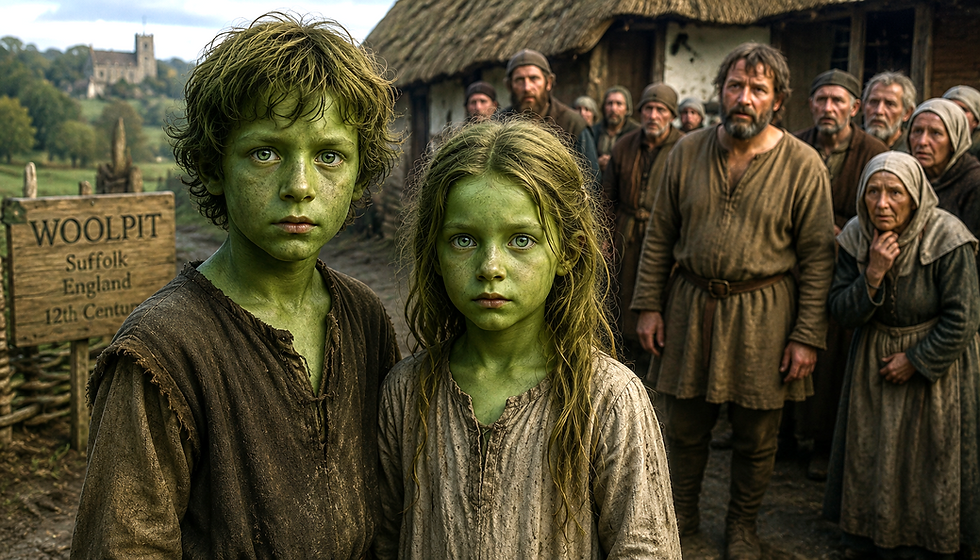
Goblins are generally described as standing between two and four feet tall. They possess lean but muscular bodies, disproportionately long arms, and short, powerful legs. Their skin is often reported as grey, brown, greenish or earthy in colour, helping them blend into natural surroundings.
Their heads are usually large compared to their bodies, with pointed or elongated ears and oversized eyes adapted to darkness. Witnesses frequently describe yellow, amber or reddish eyes that appear reflective in low light. Their noses are often hooked or flattened, while their mouths contain unusually sharp teeth. Sparse hair or complete baldness is commonly reported.
Many accounts also describe swift, jerky movements. Rather than walking normally, goblins are often said to dart rapidly between rocks or vegetation with surprising agility. Their voices are frequently described as high-pitched, raspy or chattering.

Goblins and Hobgoblins
Although the names are sometimes used interchangeably, folklore traditionally distinguishes goblins from hobgoblins. Goblins are generally viewed as troublesome, unpredictable or even dangerous creatures. They may steal food, frighten travellers or lure people away from safe paths.
Hobgoblins, by contrast, often occupy a more helpful role. In British folklore, they are household spirits who perform small tasks during the night, provided they are treated respectfully. They resemble the Scottish brownie, another domestic supernatural being known for assisting families without seeking payment.

Over time, folklore scholars grouped goblins alongside brownies, boggarts, kobolds, redcaps, duendes, pukas and various forms of nature spirits. While each possesses unique characteristics, they all belong to a broader family of legendary humanoid entities associated with hidden places, liminal spaces and the unseen world.
Paranormal Theories About Goblins
For those who believe goblins may represent genuine paranormal phenomena, numerous theories have been proposed.
One popular suggestion is that goblins are interdimensional beings. Rather than inhabiting another planet, they may exist within another layer of reality that occasionally overlaps with our own. Reports of creatures suddenly appearing and disappearing without leaving tracks are sometimes interpreted as evidence of brief dimensional crossings.
Another long-standing theory places goblins within the Hollow Earth tradition. According to this hypothesis, extensive subterranean environments may support unknown life forms hidden beneath the Earth's surface. Goblins are therefore imagined as inhabitants of vast underground civilisations that rarely emerge above ground.
Some paranormal researchers associate goblins with elemental spirits connected to the earth itself. In this interpretation, they represent conscious intelligences linked with geological features such as caves, mountains and ancient stone formations.
Others suggest they may be thoughtforms, entities created or strengthened by centuries of collective human belief. Similar ideas appear in some esoteric traditions, where sustained mental focus is believed to be capable of producing independent psychic manifestations.
Scientific Perspectives
Science approaches goblin reports very differently. Most researchers consider goblins to be products of folklore, psychology and cultural storytelling rather than undiscovered biological creatures.
Low-light conditions can significantly affect human perception. Shadows, unusual animals and partially seen figures can easily be misidentified, particularly when witnesses are already anxious or expecting something unusual.
Memory also changes over time. Psychological research shows that recollections are reconstructed rather than replayed exactly, allowing imagination, suggestion and cultural expectations to influence later accounts.
It cannot be ignored that reports of both goblins and hobgoblins might even be badly observed extraterrestrial entities that are merely differentiated by species and have been visiting Earth for several millennia.
Parapsychology occupies an interesting middle ground. While it does not claim goblins exist as physical creatures, some researchers investigate whether unusual experiences involving goblin-like entities could represent altered states of consciousness, spontaneous hallucinations, sleep-related phenomena, or experiences that remain poorly understood. Although parapsychology continues to investigate exceptional human experiences, no widely accepted scientific evidence has confirmed the objective existence of goblins.

A Mystery That Endures
Whether viewed as folklore, misunderstood natural phenomena, psychological experiences or genuine paranormal entities, goblins continue to occupy a unique place in human culture. Their remarkable consistency across widely separated societies raises fascinating questions, even if those similarities can be explained in several different ways.
For believers, goblins may represent elusive inhabitants of hidden worlds that occasionally intersect with our own. For sceptics, they illustrate humanity's remarkable ability to create enduring myths from fear, imagination and storytelling. Between these positions lies a wide spectrum of possibilities, leaving each reader free to decide whether goblins belong solely to legend or whether they may still lurk, unseen, in the forgotten corners of our world.
Help, if Needed.
If you or someone you know repeatedly dismisses strange experiences while quietly feeling unsettled, early guidance can prevent escalation. Confidential help is available from Paranormal Rescue, which operates as a sort of fifth emergency service, addressing incidents that fall outside the remit of police, fire, medical, or breakdown services. When unexplained disturbances disrupt normal life, Paranormal Rescue provides calm, structured, evidence-based support.

Written by Brian Sterling-Vete, PhD and Helen Renée Wuorio, TM, RM.
Founders of the Paranormal Rescue Organisation - www.ParanormalRescue.com
British-born Brian Sterling-Vete is a veteran science-based paranormal researcher, field investigator, quantum consciousness researcher, and author with decades of experience researching unexplained phenomena.

American-born Helen Renée Wuorio is a Tarot Master, Reiki Master Teacher, and author. She specialises in intuitive perception, historical symbolism, and research into experiential and quantum consciousness.
Together, they head Paranormal Rescue, a global organisation offering a unique and discreet emergency assistance service and support for those dealing with complex, malevolent and occasionally dangerous paranormal situations.


Comments